Project Overview
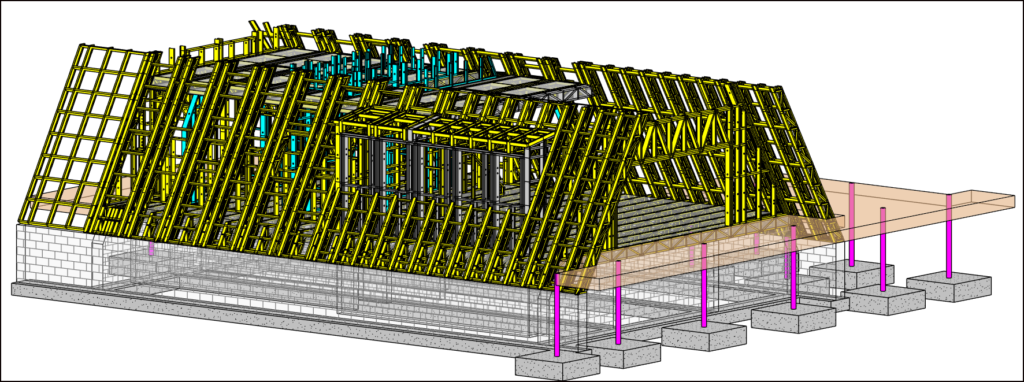
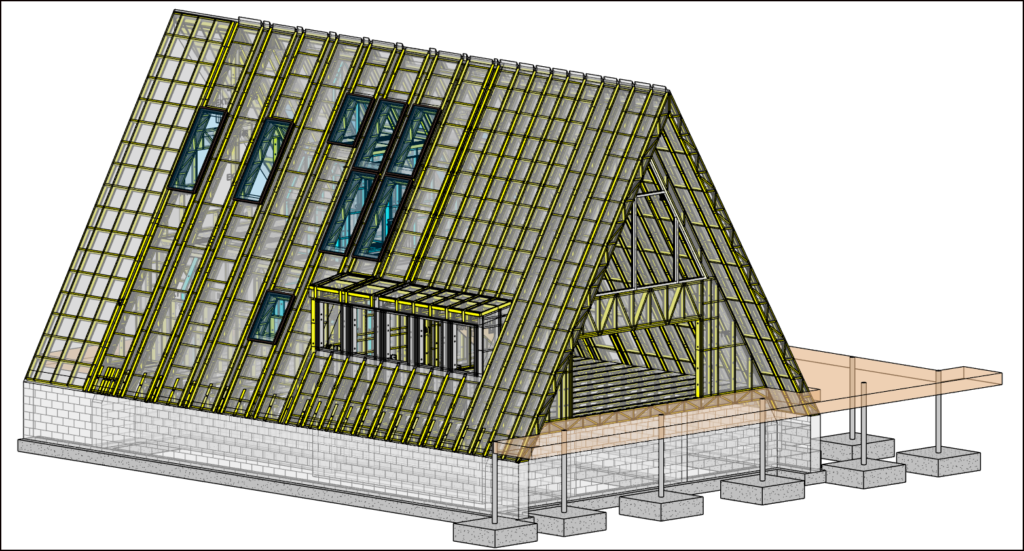
Modern residential buildings require a well-engineered foundation system that ensures durability, accessibility, and long-term performance. This 2,048 sq. ft., two-storey residential building of prefab homes in California, USA was designed and engineered by UBC BIM using advanced BIM and Light Gauge Steel Framing (LGSF) technologies.
The project features a Pitched roof system, independent floor trusses, and a stem wall foundation, creating a structurally efficient and construction-friendly residential solution. Building information modelling services from LOD 100 to LOD 500 in USA for both light gauge steel and timber framed structures
Project Details
- Project Type: Residential Building
- Built-up Area: 2,048 sq. ft.
- Storeys: 2-Storey
- Roof Type: Pitched Roof
- Foundation Type: Stem Wall
- Structural System: Independent Floor Trusses
Understanding the Stem Wall Foundation
A stem wall foundation for two storey residential building in California, USA consists of a concrete wall that extends from the footing up to the finished floor level, forming a raised platform for the building structure. In this project, the stem wall plays a crucial role in supporting the Light Gauge Steel framing system and independent floor trusses.
A stem wall foundation differs from a normal slab foundation in the way it supports the building and interacts with the ground. In a stem wall system, the structure is supported on concrete footings and short vertical walls that raise the building above ground level, creating a crawl space. This design improves moisture protection, allows easy access for plumbing and electrical services, and performs better on sloped or uneven sites. It is especially suitable for buildings with independent floor trusses, light gauge steel framing or hybrid structural systems.
In contrast, a normal slab-on-grade foundation supports the building directly on a concrete slab poured at ground level. The slab acts as both the foundation and the floor, eliminating any crawl space. While this approach is faster and more economical to construct, it offers limited flexibility for future maintenance, is more sensitive to soil movement, and provides less protection against ground moisture. Slab foundations are best suited for flat sites with stable soil conditions and simpler structural requirements.
Why a Stem Wall Foundation Was Chosen
Engineering stem wall foundation was selected due to its multiple structural and practical advantages:
- Elevates the building above ground level, protecting it from moisture intrusion and minor flooding
- Provides a continuous and level load path for transferring building loads safely to the footings
- Enhances durability and longevity of the structure
- Creates a functional crawl space, allowing easy access for plumbing, electrical, and HVAC services
Importance of Stem Wall Foundation in Residential Construction
For two-storey residential buildings, a stem wall foundation offers several key benefits:
- Structural Stability
The stem wall acts as a rigid support system that evenly distributes loads from the superstructure. When combined with Light Gauge Steel framing, it ensures excellent resistance to settlement and structural movement.
- Compatibility with Independent Floor Trusses
In this project, independent floor trusses rest on the stem wall, allowing:
- Clear access to the crawl space
- Flexible routing of services
- Simplified future maintenance or upgrades
This integration significantly improves constructability and usability compared to slab-on-grade foundations.
- Moisture and Pest Protection
By raising the building above ground, the stem wall minimizes:
- Moisture penetration
- Termite and pest risks
- Long-term deterioration of structural components
- Construction Efficiency
Stem wall foundations allow framing to begin on a clean, level surface, improving installation speed and accuracy—especially important when working with prefabricated Light Gauge Steel components.
Key Engineering Highlights
- Stem wall foundation designed to support two-storey loads efficiently
- Independent floor trusses enabling uninterrupted crawl space access
- Pitched roof system optimized for structural performance
- Fully coordinated engineering and detailing through BIM workflows
Conclusion
This two-storey residential project demonstrates the importance of a well-designed stem wall foundation combined with Light Gauge Steel framing and modern BIM technologies. Through careful engineering, detailed modelling, and automated production, UBC BIM delivered a structurally sound, durable, and construction-efficient residential solution. UBC offers permit sets, pre-bid packages with 3D BIM model along with bill of materials for project cost estimation, modelling and detailing services, engineering calculations for light gauge steel/cold formed steel/ timber framed building structures in California, USA.