
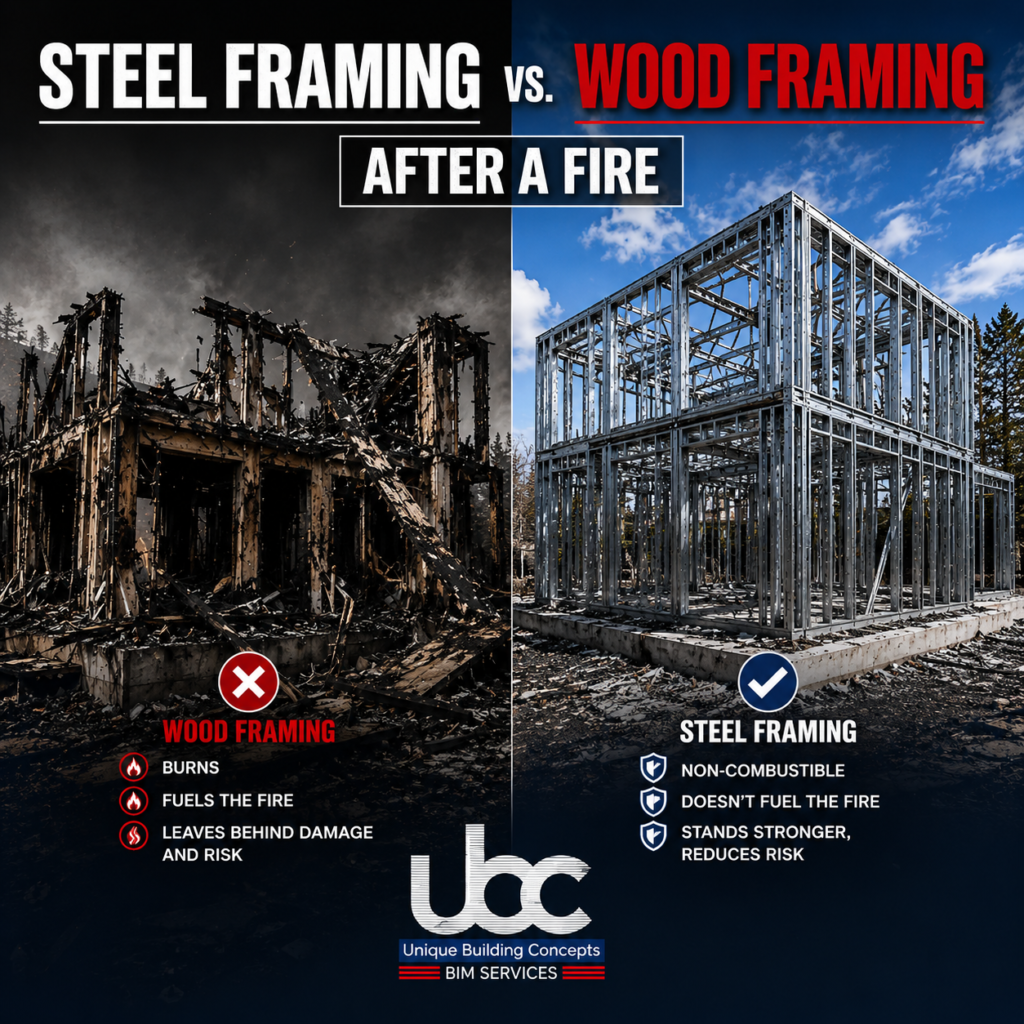
One of these materials feeds the fire. The other doesn’t. Here’s the honest comparison — including where steel isn’t the magic answer.
After a wildfire moves through a neighbourhood, the difference between what’s standing and what’s ash often comes down to one decision made months earlier: what the walls were framed with.
The reason is simple. Wood is fuel. Cold-formed steel isn’t.
What actually happens to each material
Wood framing is combustible. It ignites at relatively low temperatures, adds fuel to the fire, and accelerates how fast flames spread through a structure. In documented wildfire cases in Pacific Palisades and Malibu, fire consumed the plywood and wood components of homes while non-combustible framing nearby fared very differently.
Cold-formed steel (CFS) framing is non-combustible per ASTM E136. It doesn’t ignite, doesn’t feed the fire, and doesn’t produce smoke or toxic combustion products as it heats. It provides no means for a fire to start and nothing for a fire to spread through.
The honest part: steel isn’t “fireproof”
Here’s what steel salespeople don’t always tell you. Steel doesn’t burn, but it does lose strength at very high temperatures. Cold-formed steel is thinner than structural steel, which makes it more sensitive to heat, which is exactly why fire-rated assemblies (the right sheathing, gypsum layers, and detailing) matter.
But the degradation is favourable and predictable. According to the Steel Construction Institute, cold-formed steel retains 100% of its strength at 200°C and 95% at 300°C. It weakens gradually under extreme heat rather than adding to the fire. Wood, by contrast, is gone.
Why does this show up in your insurance bill?
Fire performance isn’t just a safety story — it’s a financial one. Insurance underwriters classify buildings by construction type, and non-combustible construction consistently earns better rates. Per Steel Framing Industry Association data, builder’s risk premiums for CFS projects can run 25–75% lower than comparable wood-framed projects. Over a 30-year lifecycle, cumulative insurance savings on a mid-size multi-family building can exceed $600,000.
Building codes recognise this too. The International Building Code classifies CFS as non-combustible, unlocking greater allowable height and area than wood-framed Type III or Type V construction — and letting mid-rise projects skip the concrete podium that wood over four stories typically requires.
The takeaway
In a world of worsening wildfire seasons, tightening insurance markets, and stricter codes, the framing decision carries more weight than it used to. Wood framing can be hardened. Steel framing starts non-combustible — no treatment, no extra layers to achieve the classification.
After the fire, that difference is the one you can see from the street.