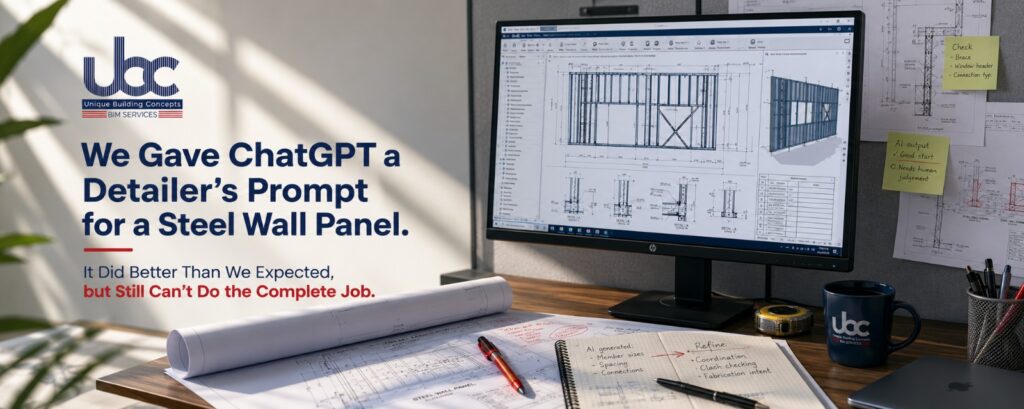
Prompt it like an amateur, and you get mush. Prompt it like a detailer, and you get real member sizes, load checks, and a fabrication schedule. Both results point to the same conclusion — and it isn’t the one the “AI will replace us” crowd is selling.
Everyone in steel framing is having the same argument right now: Can AI just do the drawings? So instead of guessing, we ran the test. We asked ChatGPT to detail a load-bearing cold-formed steel wall panel — and we prompted it the way a detailer actually thinks, not the way a curious beginner would.
That distinction is the whole story, so hold onto it. A vague question gets a vague answer. So we handed it a real brief: a location for the loads, the governing codes, sensible load assumptions, and a demand for exact profiles with checks — the same things a detailer pins down before drawing a single member.
What came back surprised us.
Can ChatGPT detail a cold-formed steel wall panel? With a precise, engineering-literate prompt, it can produce a credible first pass — real SSMA member sizes (600S162-54 studs, 600T150-54 track), stated load assumptions, capacity checks, and a fabrication schedule. What it cannot do is use your project’s actual loads, coordinate the drawing against the real plans, verify the math under a license, or seal the submittal. It accelerates a detailer. It doesn’t replace one.
The prompt is the whole story
Here’s the prompt that changed the result:
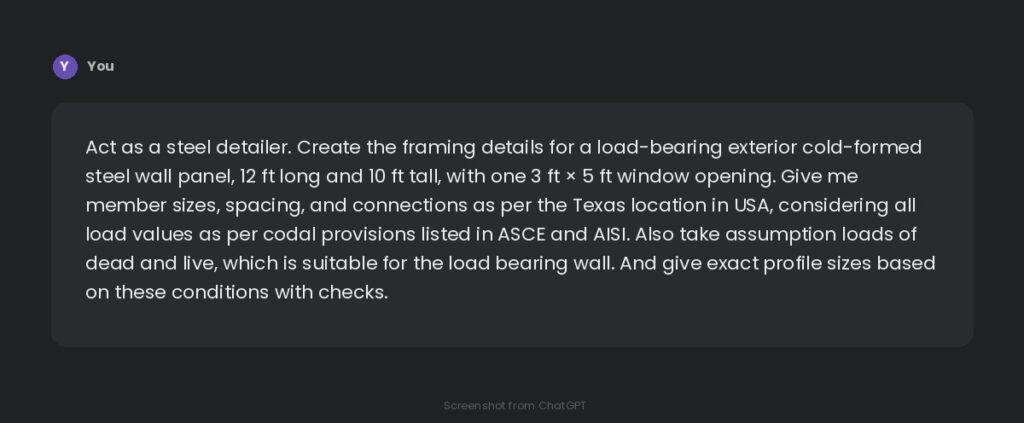
Read that again, because it’s the real lesson hiding in plain sight. That prompt names a location for the wind and seismic data, points to ASCE 7 for the loads and AISI for the cold-formed steel design, sets load assumptions, and demands checks. Ask a chatbot a vague question and you get a vague answer; give it a brief like this and you get something else entirely. The difference isn’t the AI — it’s the prompt.
And here’s the part the “AI is coming for your job” crowd skips: that prompt could only be written by someone who already knows how to detail a panel. ChatGPT didn’t know to ask for ASCE 7 wind by exposure category, AISI capacity checks, a deflection limit, or which profiles to consider. A detailer did. The tool rewards expertise. It doesn’t supply it.
Credit where it’s due — what it got right
It didn’t just spit out a parts list. It worked through roughly a dozen sections — load assumptions, code references, combinations, member checks — and landed on this fabrication schedule:
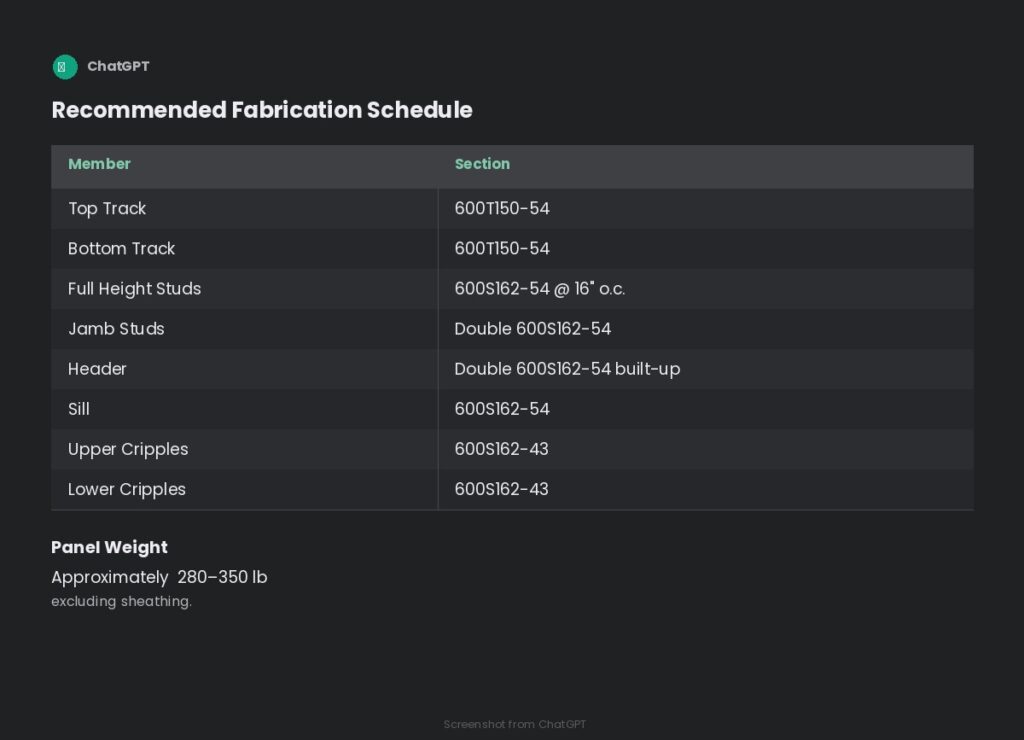
As detailers, we’ll be honest: this is good. Look at what it got right.
- It picked a compatible system. A 600T150-54 track is sized to actually receive a 600S162-54 stud — right web depth, right thickness. It didn’t mismatch the track to the stud, which is a mistake real people make.
- It used real designations with the right thickness. 600S162-54 is a 6″ stud, 1⅔″ flange, 54 mil — 16-gauge, the grade you’d expect for a 10-ft load-bearing exterior wall. Not “16-gauge,” an actual section a roll-former can run.
- It framed the opening like a pro. Doubled (built-up) jamb studs, a built-up header, a sill, and separate cripples above and below — the correct anatomy, not a single king stud.
- It used judgment on the cripples. Dropping the upper and lower cripples to 600S162-43 (lighter 18-ga) because they carry less is exactly the kind of call a good detailer makes. That detail told me it wasn’t just pattern-matching.
- It even estimated a panel weight. 280–350 lb, excluding sheathing, is a believable ballpark for a 12×10 panel — useful for crane and handling planning.
Five years ago this was unthinkable. If you handed us this schedule as the starting point for a panel, we’d say: not bad. Now here’s why your factory still can’t build from it.
Why can’t it still do the complete job
Our senior detailer read the whole output, nodded at the schedule, and said five words: “it can’t do everything.” He’s right, and the gaps aren’t small. They’re the part that carries all the risk.
- It assumed the loads. Your building doesn’t get assumptions. The prompt literally told it to “take assumption loads… suitable for the wall,” and it did. That’s fine for a demo and fatal for a permit. A real panel needs this building’s loads — ASCE 7 wind for the exact site, exposure, and risk category; the actual axial load coming down from the floors and roof above; the site’s seismic values. “Suitable assumptions” is precisely what a plan reviewer red-lines.
- The checks are unverified — and AI can’t be responsible for them. It says it ran checks. Against its own assumed loads, with math nobody has confirmed. Every capacity check still has to be independently verified by a licensed engineer. The AI can produce a number; it cannot stand behind it.
- It can’t put a stamp on it. This is the wall it hits. A panel drawing is a deferred submittal that needs a professional engineer’s seal, coordinated with the project’s engineer of record. ChatGPT has no license, no liability, and no insurance. It will hand you a confident, unsigned drawing — and the legal exposure for building from it is 100% yours.
- A schedule is a parts list, not a coordinated shop drawing. What it produced is a list of members and sizes — genuinely useful, but not what a factory builds from. The deliverable is a dimensioned, drawn panel: real geometry, connection details drawn out (not just “built-up”), fasteners specified to the forces, piece marks tied to the model, panel tags, the roll-former file, and — critically — coordination against the architectural, structural, and MEP drawings so the opening doesn’t fight a duct and the hold-down doesn’t land on an anchor bolt. AI wrote the list. Humans draw and coordinate the panel.
- It doesn’t know your project, and doesn’t know what it doesn’t know. It can’t read the EOR’s general notes, the architect’s elevations, or the field conditions, so it filled the gaps with reasonable defaults. But it won’t flag the deflection track for the structure above, the shear-wall hold-downs if this is a braced line, or the fire and acoustic assembly requirements — unless you knew to ask. The expertise is in the questions, and the tool can’t ask them of itself.
The real lesson (and it’s the opposite of the panic)
Here’s what the test actually taught us. The better these tools get, the more the value moves to the things they can’t touch — the real inputs, the verification, the coordination, the stamp, and the accountability. A smarter model writes a cleaner schedule. It still doesn’t have your project’s loads, your EOR’s standards, or a license it can legally sign with.
So the detailer’s job isn’t typing. It’s knowing exactly what to specify, catching what the AI quietly assumed, coordinating the drawing against the real plans, and putting a name on the result. AI made the literate first 70% faster. We own the last 30% — the part that carries 100% of the risk.
We use these tools every day at UBC, and hard. That’s exactly why we can tell you where they stop. The skill was never the schedule. It’s the prompt that only a detailer could write — and the seal only an engineer can give.
If you’re weighing AI against a detailing partner for your cold-formed steel work, ask the harder question: who supplies the real loads, coordinates the drawing, and owns the stamp?
That’s what we do at ubcbim — fabrication-ready LGSF and cold-formed steel shop drawings, detailed to your roll-former and sealed for submittal. Send us one panel and see the difference between a schedule and a drawing.
FAQs
Can ChatGPT do steel detailing?
With a precise, engineering-literate prompt it can produce a credible first pass — real cold-formed steel member designations, stated load assumptions, capacity checks, and a fabrication schedule. But it cannot use a project’s actual loads, coordinate the drawing against the real architectural and structural plans, verify the engineering under a license, or apply the seal a deferred submittal requires. It is a powerful assistant, not a buildable, code-compliant deliverable on its own.
Does a better prompt fix the problem?
A better prompt dramatically improves the output — but writing that prompt requires already knowing how to detail. You have to know to specify the ASCE 7 loads, the AISI checks, the deflection limits, and the right profiles. The AI doesn’t supply that expertise; it amplifies it. The gap it cannot close is the project-specific data and the professional accountability, no matter how good the prompt is.
Will AI replace steel detailers?
Not the part that carries risk. AI is already a strong assistant for first-pass sizing and repetitive modeling, and good teams use it. But detailing a cold-formed steel panel requires the project’s real loads, coordination with the actual drawings, and a licensed engineer’s seal — none of which live in a chat prompt. The role shifts toward specifying inputs, verifying, coordinating, and taking responsibility.
Why can’t AI just rely on its own load checks?
Because the checks are only as valid as the loads behind them, and the AI assumed those loads rather than deriving them from the project. The numbers also need independent verification by a professional engineer who can be held responsible. An unverified check on assumed loads is a starting point, not a basis for fabrication.
What does a real shop drawing include that ChatGPT’s schedule leaves out?
Coordinated geometry and dimensions to fabrication tolerance, drawn connection details and fastener specs tied to actual forces, the head-of-wall deflection detail, bottom-track anchorage, piece marks and panel tags tied to the model, the roll-former file, clash coordination with the architectural, structural, and MEP drawings, code references, and a professional engineer’s seal. ChatGPT’s schedule is a member list — a useful input to all of that, not a substitute for it.
