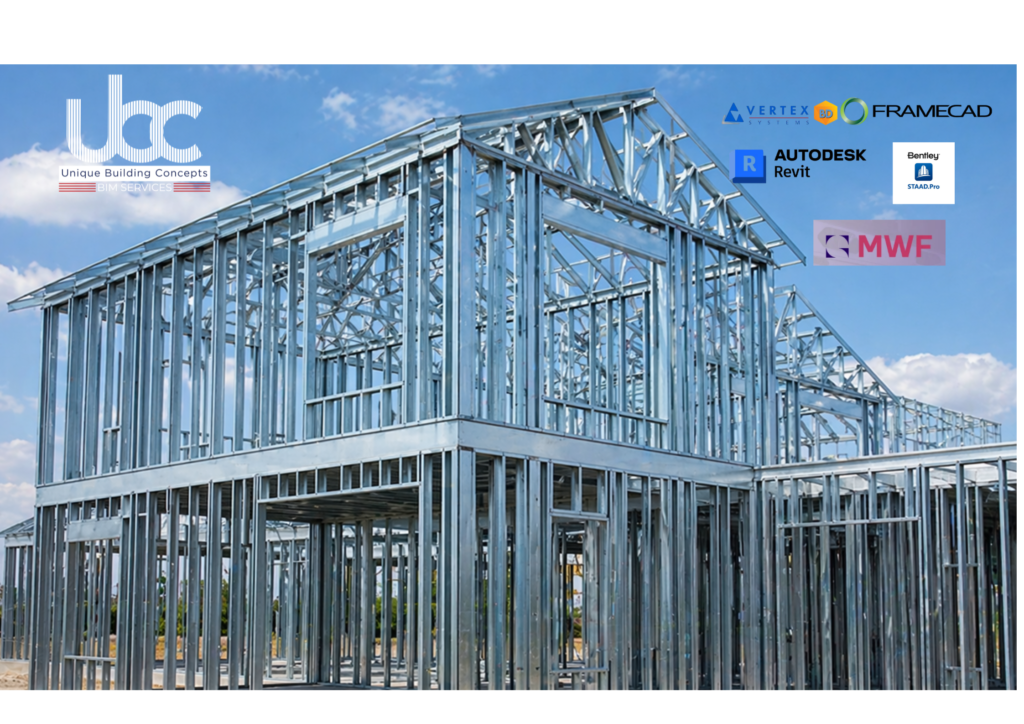
A working detailer’s guide to the 5 platforms that actually ship light-gauge steel framing projects today.
TL;DR: Five software platforms dominate LGSF detailing in 2026 — Vertex BD, Framecad, Scottsdale Scottsteel, Revit with MWF (Strucsoft), and StaadPro for structural analysis. The right stack depends on whether you’re a panel manufacturer, a residential builder, or a structural engineer. Here’s how the working detailers we know actually pick.
What software do LGSF detailers actually use?
After detailing 783 light-gauge steel framing projects across 12 countries — across the US, UK, Australia, and Canada — our team has touched every major platform in the cold-formed steel (CFS) detailing space. The honest answer to “what’s the best software for LGSF?” is: it depends on your fabrication floor and your project mix. Most professional LGSF operations end up running 2–3 tools in parallel.
This guide breaks down the six platforms that matter in 2026, what each does best, and where each one falls short — with no vendor bias.
Quick comparison: the LGSF detailing software stack in 2026
1. Vertex BD
Vertex BD Software is the leading cold-formed steel design software for prefab, modular, residential, and commercial construction. If you panelize, this is where most US LGSF manufacturers start.
What it does:
- Automates wall, floor, ceiling, and roof panel fabrication drawings from one BIM model
- Generates CSV exports directly to roll-forming machines ( Arkitech Advanced Construction Technologies ,Pinnacle, HOWICK LTD )
- Lot-specific drawing automation for production home builders
- Strong cut-list, BoM, and material-report generation
- Equally usable for LGSF and timber framing — useful for hybrid shops
Best for: Production home builders, prefab panel manufacturers, kit-home companies, modular housing operations.
2. Framecad
FRAMECAD is a closed, vertically-integrated ecosystem — proprietary detailing software paired with proprietary roll-forming machines, optimized for speed from design to factory floor.
What it does:
- Single workflow from design → roll-formed panel
- Strong factory-floor integration with Framecad machines
- Used globally for LGSF, with particularly strong presence in Australia, New Zealand, the UK, and the Middle East
- Robust code support across multiple regions
Best for: Manufacturers running Framecad roll-formers; builders launching greenfield LGSF operations who want a single-vendor stack.
3. Scottsdale Scottsteel
Scottsdale Construction Systems’ Scottsteel software is the dominant LGSF design platform for North American manufacturers running Scottsdale FrameMaster roll-formers, especially across the US sun-belt.
What it does:
- Tight integration with Scottsdale FrameMaster roll-forming machines
- Strong code library for IRC, IBC, and Canadian building codes
- Handles US residential framing conventions natively
- Common across the Texas, Arizona, Florida, and Pacific Northwest LGSF markets
Best for: Manufacturers running Scottsdale roll-formers in the US and Canadian markets.
4. Revit + MWF (Strucsoft)
Revit Automation & Customization Training and Project Consultant with the MWF (Metal Wood Framer) add-in by Strucsoft is the standard LGSF detailing path when the project is BIM-coordinated with MEP, architectural, and structural disciplines — typical for commercial and mid-rise residential.
What it does:
- Lives inside Autodesk’s BIM ecosystem — easy clash detection with MEP and structural
- Plays well with architectural teams already working in Revit
- Strong for complex multi-storey commercial LGSF
- Coordinates wood and steel framing inside one shared model
Best for: Mid-rise multi-family buildings, hotels, hospitals, mixed-use developments, and projects where MEP/structural clash detection matters.
5. StaadPro / Strap
@STAAD.Pro and ATIR Engineering Software Development Ltd are the structural finite-element analysis engines that validate LGSF designs against gravity, wind, and seismic loads — and produce the calculations needed for engineer-of-record (EOR) sealed sets.
What they do:
- Industry-standard finite-element structural analysis
- US (IBC/ASCE), Indian (IS), European (Eurocode) code libraries built in
- Required for sealed structural drawings in most US states
- Outputs feed back into detailing software for member sizing
Best for: Structural engineering teams sealing LGSF designs; any project requiring an engineer-of-record stamp.
How to choose your LGSF software stack in 2026
Most working US LGSF operations end up with a hybrid stack of 2–3 tools:
The shop floor decides the detailer. The project complexity decides the BIM tool. Code requirements decide the analysis tool.
FAQ’s
Is LGSF detailing software suitable for modular construction?
Yes. Software platforms like Vertex BD and Framecad are extensively used for modular construction because they automate panel layouts, fabrication drawings, material optimization, and production workflows.
What is the role of BIM in LGSF construction?
BIM enables accurate 3D modeling, clash detection, coordination between architectural, structural, and MEP disciplines, and smoother communication from design through fabrication and installation.
How do LGSF detailers select the right software for a project?
The choice depends on factors such as the roll-forming machine, project type, building complexity, required BIM coordination, local building codes, and engineering requirements.
How does LGSF software reduce construction time?
By automating design, detailing, and production files, LGSF software allows components to be manufactured off-site with high precision, reducing on-site labor and accelerating project delivery.
Contact UBCBIM to learn more.
