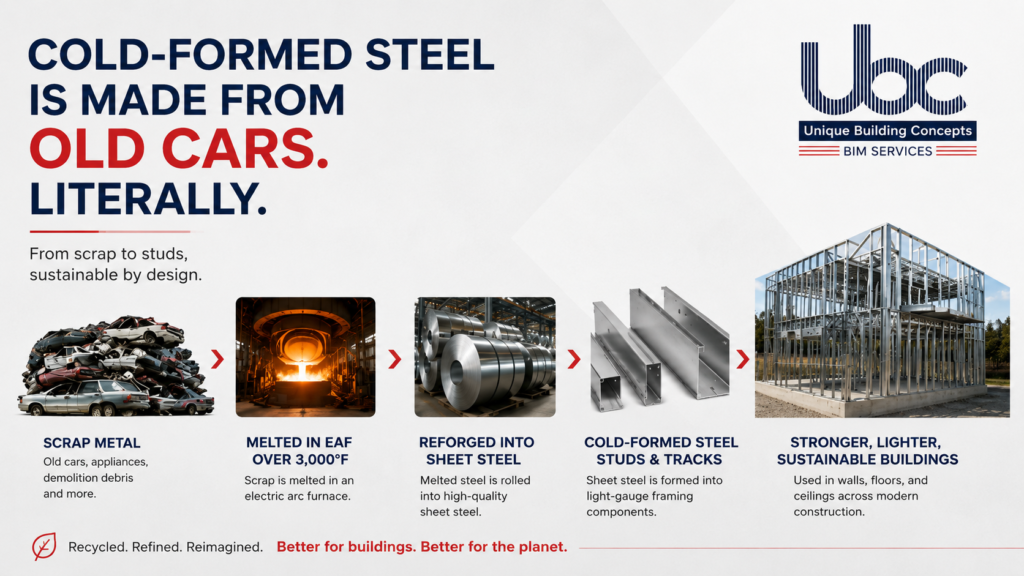
The wall panels in your building most probably started life as scrapped vehicles, old appliances, and demolished structures. Here’s how.
Most people assume steel framing starts in a mine. It doesn’t.
The cold-formed steel studs, tracks, and panels that frame buildings across the U.S. start as scrap metal — old cars, scrapped appliances, demolished structures, even leftover manufacturing offcuts. That scrap gets fed into an electric arc furnace, melted at over 3,000°F, and reforged into the sheet steel that becomes the light-gauge steel framing in your walls, ceilings, and floors.
This isn’t a niche process. Electric arc furnaces now account for roughly 70% of all steel produced in the United States, and that share is heading toward 90% by 2040. The input is 80–100% recycled scrap. When we say cold-formed steel is made from old cars, we mean it literally — the atoms in your wall panel may have been a Honda Civic ten years ago.
Why this matters beyond the fun fact
The environmental math is real. Melting recycled scrap in an EAF uses about 75% less energy than smelting virgin iron ore in a traditional blast furnace. CO₂ emissions drop by 58–70% per ton. And at end of life, every steel stud is 100% recyclable — it goes right back into the furnace and becomes another building. Not downcycled. Not landfilled. Recycled into the same product, indefinitely.
The U.S. already sits on a scrap reservoir of over 4 billion tons and growing. That’s not a supply-chain vulnerability — it’s a domestic advantage. Especially in a year when tariffs have pushed imported steel prices up over 20%, the fact that most CFS comes from domestically melted scrap isn’t just a sustainability story. It’s a pricing and supply story too.
What this means for your next project
If you’re a developer weighing steel framing against wood or concrete, the carbon conversation has shifted. Cold-formed steel framing carries some of the lowest embodied carbon of any structural material — not because of a marketing claim, but because of what it’s actually made from.
If you’re a factory owner or fabricator, the material you run through your roll-former was never mined. It was recycled.
And if you’ve never thought about where a steel stud comes from before reading this, now you know. It was probably someone’s car.
FAQ
What is cold-formed steel made from? Cold-formed steel is made primarily from recycled scrap metal — old vehicles, appliances, demolished buildings, and manufacturing offcuts — melted in electric arc furnaces and reformed into sheet steel. EAF steelmaking uses 80–100% recycled scrap as its raw material input.
Is cold-formed steel framing sustainable? Yes. CFS is one of the most sustainable structural framing materials available. It is made from recycled scrap, produced in electric arc furnaces that use 75% less energy and emit 58–70% less CO₂ than traditional blast furnaces, and is 100% recyclable at end of life without any loss in quality.
How much U.S. steel comes from recycled scrap? Approximately 70% of all U.S. steel is now produced in electric arc furnaces using recycled scrap, and that figure is projected to reach 90% by 2040.
Can steel be recycled indefinitely? Yes. Steel can be melted and reformed without degrading its structural properties. A steel stud removed from a demolished building can be recycled into a new stud for a new building. This makes steel one of the few truly circular construction materials.